OnSight is mixed-reality software that allows scientists and engineers to virtually walk and meet on Mars. It was created by NASA’s Jet Propulsion Laboratory, in collaboration with Microsoft, for the HoloLens. The software won NASA’s Software of the Year Award 2018. For more about NASA’s exploration of Mars, visit https://mars.nasa.gov
When you work at a factory that pumps out thousands of a single item, like iPhones or shoes, you quickly become an expert in the assembly process. But when you are making something like a spacecraft, that comfort level doesn’t come quite so easily.
“Just about every time, we are building something for the first time,” says Brian O’Connor, the vice president of production operations at Lockheed Martin Space.
Traditionally, aerospace organizations have replied upon thousand-page paper manuals to relay instructions to their workers. In recent years, firms like Boeing and Airbus have started experimenting with augmented reality, but it’s rarely progressed beyond the testing phase. At Lockheed, at least, that’s changing. The firm’s employees are now using AR to do their jobs every single day.
This piece first appeared in our twice-weekly newsletter, Clocking In, which covers how technology is transforming the future of work. Sign up here—it’s free!
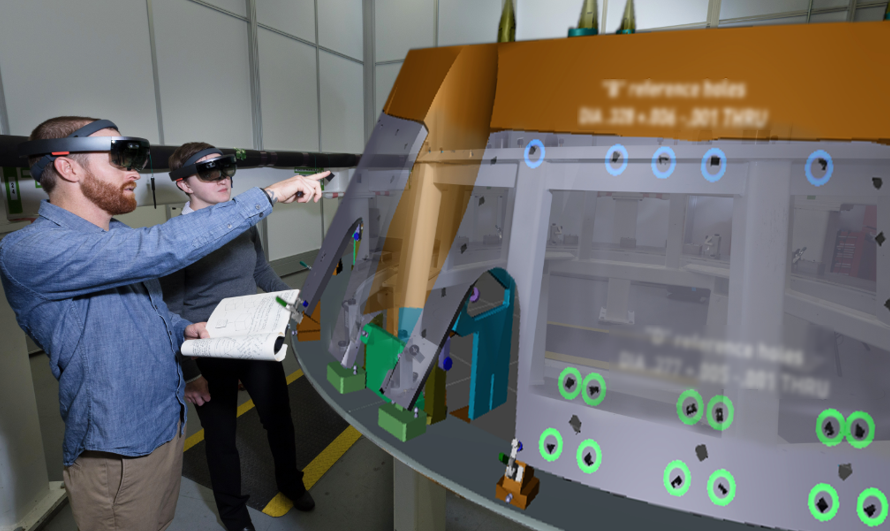
Spacecraft technician Decker Jory uses a Microsoft HoloLens headset on a daily basis for his work on Orion, the spacecraft intended to one day sit atop the powerful—and repeatedly delayed—NASA Space Launch System. “At the start of the day, I put on the device to get accustomed to what we will be doing in the morning,” says Jory. He takes the headset off when he is ready to start drilling. For now, the longest he can wear it without it getting uncomfortable or too heavy is about three hours. So he and his team of assemblers use it to learn a task or check the directions in 15-minute increments rather than for a constant feed of instructions.
LOCKHEED MARTIN
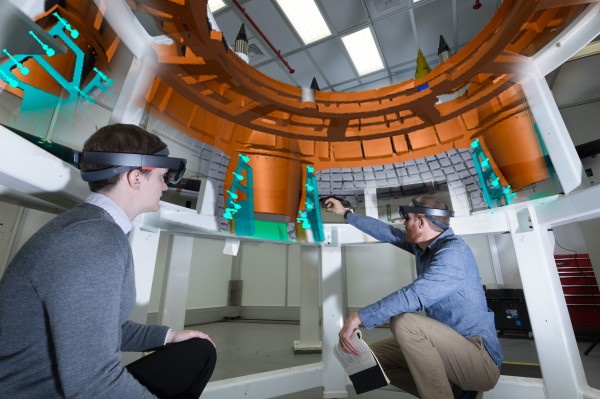
In the headset, the workers can see holograms displaying models that are created through engineering design software from Scope AR. Models of parts and labels are overlaid on already assembled pieces of spacecraft. Information like torquing instructions—how to twist things—can be displayed right on top of the holes to which they are relevant, and workers can see what the finished product will look like.
The virtual models around the workers are even color-coded to the role of the person using the headset. For Jory’s team, which is currently constructing the heat shield skeleton of Orion, the new technology takes the place of a 1,500-page binder full of written work instructions.
Lockheed is expanding its use of augmented reality after seeing some dramatic effects during testing. Technicians needed far less time to get familiar with and prepare for a new task or to understand and perform processes like drilling holes and twisting fasteners.
LOCKHEED MARTIN
These results are prompting the organization to expand its ambitions for the headsets: one day it hopes to use them in space. Lockheed Martin’s head of emerging technologies, Shelley Peterson, says the way workers use the headsets back here on Earth gives insight into how augmented reality could help astronauts maintain the spacecraft the firm helped build. “What we want astronauts to be able to do is have maintenance capability that’s much more intuitive than going through text or drawing content,” says Peterson.
For now, these headsets still need some adjustments to increase their wearability and ease of use before they can be used in space. Creating the content the workers see is getting easier, but it still takes a lot of effort. O’Connor sees these as obstacles that can be overcome quickly, though.
“If you were to look five years down the road, I don’t think you will find an efficient manufacturing operation that doesn’t have this type of augmented reality to assist the operators,” he says.
Ogni anno 400.000 persone in Europa, 60.000 in Italia, muoiono per arresto cardiaco improvviso; molte di loro potrebbero avere maggiori possibilità di salvezza se soccorse tempestivamente e adeguatamente. Se le persone che si imbattono in una vittima di arresto cardiaco iniziassero la rianimazione cardiopolmonare prima dell’arrivo dell’ambulanza, le possibilità di sopravvivenza aumenterebbero di 2-3 volte.
Oggi solo nel 15% dei casi viene eseguita la rianimazione prima dell’arrivo dei soccorsi. Se la percentuale aumentasse al 50/60% si potrebbero salvare 100.000 ogni anno.
È per questo che, per la prima volta, da quest’anno il 16 ottobre si celebrerà il “World Restart A Heart Day” cioè il giorno mondiale di sensibilizzazione sul tema dell’arresto cardiaco che vedrà iniziative in tutto il mondo con il patrocinio dell’Organizzazione Mondiale della Salute.
In questa occasione, i ricercatori e i volontari di IRC, Italian Resuscitation Council, saranno all’interno del Parco Archeologico del Colosseo a Roma, dalle 10 alle 17 per informare sulle manovre salvavita con dimostrazioni pratiche e con la novità della realtà virtuale: sarà possibile simulare in 3D e in modo realistico una corretta procedura di rianimazione.
I ricercatori e i volontari di IRC saranno accompagnati dai volontari della Fondazione “Giorgio Castelli”, che ha formato alla rianimazione cardiopolmonare gli addetti del Parco Archeologico del Colosseo a Roma e donato 11 defibrillatori all’intera area. È prevista anche la partecipazione di volontari dell’ANPAS, della Croce Rossa Italiana, di Conacuore e di altre associazioni.
Quello del 16 ottobre, però, è solo uno degli eventi della campagna “VIVA! la settimana per la rianimazione cardiopolmonare”. Durante la settimana che quest’anno è dal 15 al 21 ottobre, saranno organizzati incontri e dimostrazioni pratiche in tutta Italia.
«Vogliamo anche quest’anno attrarre l’attenzione per spiegare come alcune semplici azioni, eseguibili da chiunque, possono salvare la vita di chi è colpito da arresto cardiaco. Per questo la nostra associazione è molto impegnata nella formazione e nella divulgazione: solo nell’ultimo anno abbiamo realizzato oltre 10.000 corsi di formazione rivolti a quasi 130.000 partecipanti tra operatori sanitari e persone comuni con particolare attenzione al mondo della scuola», dice Andrea Scapigliati, presidente di Italian Resuscitation Council e dirigente medico dell’Unità operativa di cardioanestesia e terapia intensiva cardiochirurgica della Fondazione Policlinico Universitario A. Gemelli.
«VIVA! rappresenta un’ottima occasione di sensibilizzazione per la popolazione nei confronti della cultura del primo soccorso e delle buone pratiche di rianimazione, cultura di vita e di attenzione ai bisogni primari del prossimo», aggiunge Vincenzo Castelli, presidente della Fondazione Giorgio Castelli onlus e dirigente medico della Unità di Medicina interna dell’Ospedale Vannini di Roma.
Per favorire la diffusione delle manovre salvavita, cioè il massaggio cardiaco, le ventilazioni di soccorso e la defibrillazione precoce, IRC ha creato un nuovo strumento che utilizza la realtà virtuale indirizzato non solo agli operatori sanitari ma anche alla gente comune e agli alunni delle scuole. Indossando il caschetto della realtà virtuale è possibile infatti simulare un primo soccorso su una vittima di arresto cardiaco.
Per favorire l’insegnamento nella scuola, IRC, ha inoltre ormai consolidato l’applicazione per cellulari “Un picnic mozzafiato” dedicato ai bambini della scuola primaria.
L’elenco delle iniziative della settimana VIVA! è disponibile sul sito dedicato all’iniziativa.
REALTÀ AUMENTATA, REALTÀ VIRTUALE, INTELLIGENZA ARTIFICIALE E DEEP LEARNING STANNO IMPATTANDO ANCHE IL MONDO DELL’ARCHITETTURA. LA PROLIFERAZIONE DI STRUMENTI DIGITALI CI DÀ LA POSSIBILITÀ DI TRASCENDERE – PER LA PRIMA VOLTA DA GENERAZIONI – LE PRATICHE ARCHITETTONICHE TRADIZIONALI. LA REALTÀ IMMERSIVA E IL DEEP LEARNING PROMUOVONO L’INNOVAZIONE E INTERROMPONO I FLUSSI DI LAVORO PRECEDENTI NEL SETTORE DELL’ARCHITETTURA.
Per sperimentare tutta la potenza rivoluzionaria della realtà aumentata bisogna capire che siamo di fronte a un nuovo oggetto comunicativo. E’ una nuova sintassi che sta nascendo, destinata a condizionare la comunicazione e il marketing.
This site uses cookies to ensure the best experience.Click on: "OK" for accept, on "Privacy Policy” for informations, on "No" for refuse third party non functional cookies.